
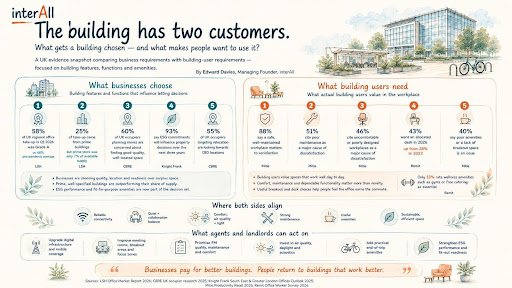
If you are short on time, we have made this easy to read by flipping the standard format:
First: We have summarised the entire article in a 60-second read.
Second: If you want to dive deeper into a specific section, you will find the full discussion below.
Finally: For those interested in our methodology, all references and supporting sources are listed at the end.
60-Second Summary
1. What the property sector needs to do
Get the fundamentals right first: Ensure excellent internet and mobile connectivity, air quality, temperature control, lighting, acoustics, maintenance, and user-friendly technology.
Make buildings genuinely useful: Provide good meeting spaces, quiet zones, breakout areas, cycle storage, showers, outdoor space, and sensible food and coffee provisions.
Make them easy to choose: Focus on location, transport links, strong ESG credentials, quality fit-out, and leasing flexibility.
Sell the outcome, not just the specification: Do not just tell an occupier there are showers—explain how the building makes active commuting easier. Do not just say it has connectivity—demonstrate that people can arrive and start working immediately.
Avoid the amenity arms race: UK employee research shows that getting the basics right matters significantly more than filling a building with gimmicks.
2. What businesses need to do
Give people a reason to be together: Foster collaboration, learning, mentoring, relationship-building, culture, and simply enjoying time with colleagues.
Coordinate when people come in: An amazing office with nobody you need to see inside it is still a poor office experience.
Make leaders visible and accessible: People need to gain something from being together that they cannot get while sitting at home.
Create different environments for different work: Provide spaces to collaborate, spaces to talk, and spaces to shut the door and concentrate.
Do not confuse attendance with engagement: Getting someone through the door is very different from making them want to return.
3. What employees can do
Be intentional about office days: Come in when there are people you need to see, conversations worth having, or tasks better done together.
Use being together properly: Talk to people outside your immediate team, share knowledge, mentor, ask questions, and have the conversations that do not happen naturally on Teams.
Tell businesses what is not working: Noise, meeting rooms, temperature, Wi-Fi, lighting, or lack of quiet space can all be fixed if organisations know about the issues.
Help create the culture you want to be part of: Culture is not something HR or the building provides for us—we all contribute to it.
Occasionally, just have a coffee with someone: Without putting 30 minutes in their diary first.
Full Article
If you have a little more time, this is the detailed discussion behind those three key points. The crucial takeaway is that none of these three groups can solve the whole problem on their own. The building, the business, and the people using it all have a part to play.
1. What the property sector needs to do
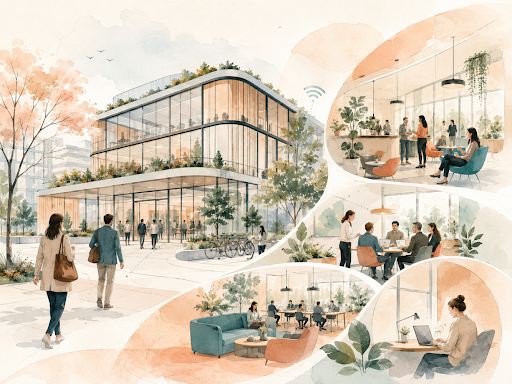
The property sector creates the conditions. That sounds obvious, but I think it is worth saying because it is very easy to get distracted by the latest amenity, technology or certification and forget what the person using the building actually experiences every day.
For landlords, developers, managing agents and letting agents, the job is not simply to provide square footage. It is to make that square footage easy to choose, easy to use and easy for an occupier to get value from.
Get the fundamentals right first
Before we get into gyms, terraces or coffee bars, the basics have to work. Reliable internet. Proper mobile coverage. Good air quality. Sensible temperatures. Lighting that works. Acoustics that let people concentrate. A building that is clean, maintained and easy to move around.
These things are not glamorous, but they are the things people notice when they go wrong. You can have the best reception in the city, but if someone cannot make a call, join a video meeting or sit comfortably for the day, that will shape how they feel about the building far more than the nice bit they walked past on the way in.
Make buildings genuinely useful
The amenities that matter are normally the ones that solve a real problem. Somewhere to meet. Somewhere quiet to make a call. Somewhere informal to sit with a colleague. Cycle storage that is actually usable. Showers that make active travel practical. Lockers. Outdoor space. Somewhere to get a coffee or some food without losing half an hour.
The key word for me is useful. An amenity should make somebody’s working day better, easier or more enjoyable. If it does that, it has value. If it is there mainly because it looks good on a brochure, I would question whether that money could have been spent on something people will use every day.
Make them easy to choose
Businesses are making a long-term commitment when they take space. They want to know the building works today, but they also need confidence that it will still work as their business changes. Location, transport, sustainability, flexibility, connectivity and the quality of the fit-out all feed into that decision.
This is where landlords can make the decision easier. Be clear about what is already there, what can change, what data is available and what the building can support. The easier it is for an occupier to understand how the building will work for them, the easier it is for an agent to sell it.
Sell the outcome, not just the specification
I think this is a big opportunity for agents. A list of features is useful, but the occupier ultimately cares about what those features do for them.
Do not just say there is fibre in the building. Explain that a tenant can arrive with resilient connectivity available and get trading quickly. Do not just say there are showers. Explain that people can genuinely cycle or run into work. Do not just say there are sensors. Explain that the occupier can understand how their space is being used, where energy is going and whether the environment is comfortable.
The specification matters, but what the specification enables matters more.
Avoid the amenity arms race
There is nothing wrong with a gym, yoga studio, games room or free breakfast. I would happily use some of them. But the research we looked at is a useful reminder that these things do not compensate for poor fundamentals.
The best question is probably not, “What else can we put in the building?” It is, “What is stopping this building from being a really good place to spend a working day?” Sometimes the answer will be a new amenity. Sometimes it will be better Wi-Fi, better acoustics, better meeting rooms or simply fixing the temperature. The latter may be less exciting, but it can matter far more.
2. What businesses need to do

Once the building has created the right conditions, the responsibility shifts. A landlord can make an office brilliant to use, but they cannot create somebody else’s company culture. That belongs to the business.
For me, this is the bit that gets lost when return-to-office becomes a conversation purely about how many days people should attend. The better question is: what are we doing with the time when people are together?
Give people a reason to be together
People generally do not travel into an office because they miss the desk. They come in for the things that are better with other people around them: collaboration, learning, mentoring, problem-solving, relationships, social connection and feeling part of something.
That means businesses need to create those opportunities deliberately. If the value of the office is people, make sure people can actually get value from each other when they are there. Build in time to share ideas, solve things together and have conversations that would never justify a formal Teams invite.
Coordinate when people come in
An amazing office with nobody you need to see in it is still a pretty poor office experience. Hybrid working only really works if there is some coordination around when teams, leaders and the people who need to collaborate are actually together.
That does not mean everybody has to be in on exactly the same days or that flexibility disappears. It just means being intentional. If Tuesday is the day a team learns, collaborates or works through problems together, make Tuesday worth travelling in for.
Make leaders visible and accessible
A big part of what people gain from being around others is access. Access to experience, judgement, context and people they can learn from. If leaders ask people to come into the office and then spend the whole day behind a closed door on video calls, we should not be surprised if people question the value of being there.
Being visible does not mean being available every second of the day. It means giving people the chance to have the five-minute conversation, ask the quick question or see how somebody more experienced handles something. A lot of learning happens this way without anybody ever calling it training.
Create different environments for different work
The office cannot just be a collaboration space. People still need to concentrate. They need to make private calls, write, think, meet clients, join virtual meetings and sometimes simply get their head down.
Businesses need to think about how their own space supports those different activities. Somewhere collaborative, somewhere social and somewhere quiet. The building can provide some of this through shared amenities, but the occupier still needs to design and manage its own workplace around how its people actually work.
Do not confuse attendance with engagement
You can measure whether somebody came through the door. That does not tell you whether the day was worthwhile.
If the objective becomes hitting an attendance number, it is very easy to miss the point. I would rather ask whether people built relationships, learned something, solved problems faster, helped a colleague or left feeling more connected to the business. Those are the outcomes that make people want to return without being forced to.
The building can help remove friction, but the business has to create purpose.
3. What employees can do
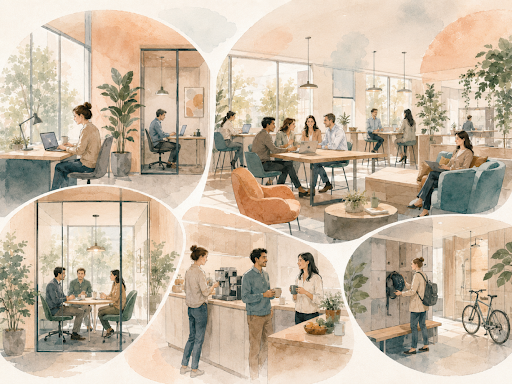
There is a third part to this as well. Employees are not passive users of culture. We all influence the environment we work in and the experience other people have when they come into it.
That does not mean the responsibility for a poor workplace should be pushed onto employees. Buildings need to work and businesses need to lead. But once those things are in place, all of us can help make being together more valuable.
Be intentional about office days
If you have flexibility over when you come in, use it. Think about who you need to see, which conversations are better face to face and what work would genuinely benefit from being done around other people.
There will always be days where getting your head down at home makes sense. Equally, there are days where one conversation in person can move something forward faster than a chain of emails. The point is not that one is better than the other. It is using each environment for what it is good at.
Use being together properly
If you have made the journey in, get something from it. Speak to the person outside your immediate team. Ask the question. Share what you know. Help somebody newer. Sit with someone rather than sending them a message from three desks away.
A lot of the value of an office is in the informal stuff. It is the conversation you did not plan, the person you bump into and the bit of context you pick up because you were there. We should not organise that out of the workplace by spending the whole day wearing headphones and talking to people on screens.
Tell businesses what is not working
If the Wi-Fi is poor, the meeting rooms are difficult to use, the temperature is wrong or there is nowhere quiet to work, say something. The same applies to the less physical things: if nobody you need to work with is ever there on the same day, that is useful feedback too.
A lot of workplace problems are fixable, but only if the landlord, facilities team or business knows they exist. Good data helps, but there will always be things that only the people using the space can tell you.
Help create the culture you want to be part of
Culture is not something HR delivers to everybody else. It is what happens between people every day. How we welcome somebody new, whether we share information, whether we help each other and whether people feel comfortable asking a question all contribute to it.
Businesses have to set the conditions for a good culture, but employees bring it to life. If we want the office to feel connected, collaborative and enjoyable, all of us have a role in making it feel that way for the people around us.
And occasionally, just have a coffee with somebody
Not every interaction needs an agenda, a calendar invite or an outcome written against it.
Some of the strongest relationships in a business are built through completely ordinary moments. A coffee. Lunch. Walking to a meeting. Five minutes after everyone else has left the room. Those relationships are what make collaboration easier later because trust already exists.
It sounds almost too simple, but that is probably the point. A lot of this is not rocket science. It is social, natural and very human.
People, performance and profit are one conversation
What I take from all of this is that the best outcome comes when the three parts work together.
The property sector creates a building that works properly and removes friction. The business creates the reason for people to be together. The people using it create the relationships and culture that make being there worthwhile.
When that happens, looking after people is not separate from commercial performance. People can work better, businesses can perform better and buildings become easier to let and retain occupiers in. Everybody benefits from the same thing being done well.
That is why I do not think people, productivity and profit need to be competing priorities. If we get the environment and the human side right, they should naturally pull in the same direction.
The research behind this article
I’ve deliberately kept the evidence separate rather than trying to blend different surveys into one made-up ranking. Some measure actual leasing behaviour, some ask business decision-makers, some survey employees, and some are agent sentiment. They tell us different things, and I think it’s important to be transparent about that.
- Lambert Smith Hampton — Mind the Gap: Office Market Report 2026
- CBRE — 2025 European Office Occupier Survey, including UK-specific responses
- Knight Frank — South East & Greater London Offices 2025
- Remit Consulting — 2026 Office Worker Survey
- Mitie — Productivity Reset / UK workplace research 2025
- Mitie — Performance over play
- Savills — National Office Agency Sentiment Survey 2026
- Savills — Central London Occupier Spotlight / Office FiT
- JLL — Future of Work Survey 2026 and workplace research
- Leesman — Workplace experience research